
Keywords
ICT tools
ADDIE model
Social Work
higher education
How to Cite
Abstract
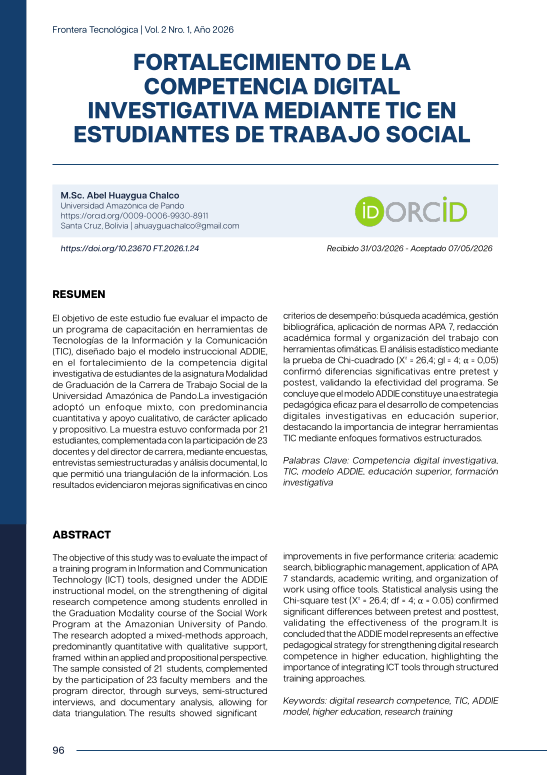
The purpose of this study was to design and implement a training program in Information and Communication Technology (ICT) tools aimed at strengthening digital research competence among students enrolled in the Graduation Modality course of the Social Work Program at the Amazonian University of Pando. The research adopted a mixed-methods approach, with a predominance of quantitative methods and qualitative support, and was characterized as applied and propositional. The sample consisted of 21 students and was complemented by the participation of 23 faculty members through semi-structured interviews, as well as an interview with the program director and a documentary analysis of curricula and institutional regulations, enabling robust data triangulation.
The program was structured under the ADDIE instructional model, comprising a comprehensive plan of five modules and sixteen workshops (78 sessions, 156 academic hours). For validation purposes, a pilot test was conducted using a strategic selection of highly accessible and impactful tools for final graduation projects: Google Scholar, Scielo, Redalyc, Zotero, Microsoft Word, Google Docs, Excel, Canva, and Google Slides.
The results demonstrated significant improvements in five performance criteria: academic search, bibliographic management, application of APA 7 standards, academic writing, and organization of work using office tools. Statistical analysis using the Chi-Square test (X² = 26.4; df = 4; α = 0.05) confirmed significant differences between pretest and posttest, validating the effectiveness of the program.
It is concluded that the ADDIE model constitutes an effective, flexible, and contextualized pedagogical strategy for the development of digital research competencies in higher education contexts with technological limitations, contributing both to the improvement of students’ academic quality and to institutional innovation in research training.

This work is licensed under a Creative Commons Attribution-NonCommercial 4.0 International License.
Copyright (c) 2026 Abel Huaygua Chalco (Autor/a)